
The problem with games that need every phone
A multiplayer app that asks ten people to download, sign up, and join a lobby creates ten points of failure. One person on Android cannot find the app. Another ran out of storage. A third refuses to create yet another account. The host troubleshoots for five minutes while the party momentum leaks away.
Even when the download works, the experience splits. People stare at their own screens instead of at each other. The game becomes ten separate interactions instead of one shared moment. For a party, where the point is being together, this defeats the purpose.
The lobby code adds another layer. Someone mistypes it, someone's session drops, someone joins late and needs a new code. Each failure point is small, but at a party they stack fast and the host ends up running tech support instead of running the night.
How the one-phone model works
One phone sits in the middle of the group. It holds the prompts, the cards, the words, and the timer. Players interact with each other, not with a screen. When a mode needs someone to see the phone, you pass it to them. When a mode runs on voice and reactions, the phone stays with the host.
The model works because it treats the phone as a deck of cards, not as a multiplayer platform. Nobody joins anything. Nobody logs in. The host opens a mode and the group plays the same way they would play a board game, but without the board.
This means a guest can arrive mid-game and join the next round without missing a beat. There is no lobby to re-enter, no sync to wait for. The phone does not know or care how many people are in the room.
It also means the phone can go in airplane mode. The game runs locally, so the network does not matter. A cabin with no signal, a basement with dead wifi, a rooftop where the bars drop. One phone, no connection, full game.
- Zero downloads for guests.
- No accounts, no lobby codes, no sync issues.
- Late arrivals join instantly.
- Works offline with no connection needed.
Which modes work best in the one-phone format
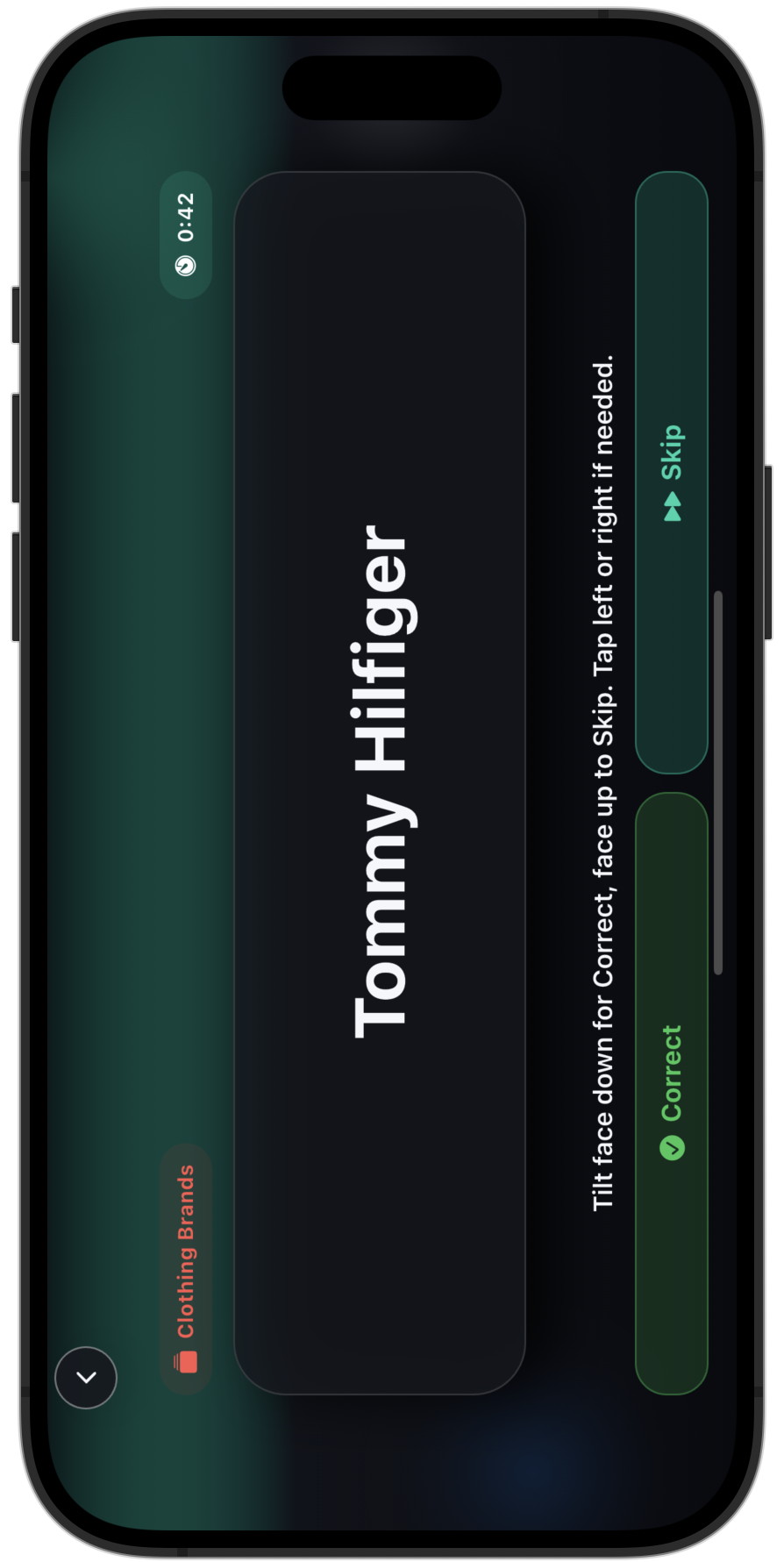
Guess That Word is the cleanest example. The guesser holds the phone on their forehead. The room shouts clues. The phone tracks the words and the round length. Nobody else touches a device.
First To Last To keeps the phone with the host. A prompt appears, the host reads it aloud or holds it up, and the group reacts. The phone is the game master and the players are the entire circle.
Card Roulette passes the phone like a deck of cards. Each player draws, reads their prompt, and acts. Then the phone moves to the next person. The mechanic is identical to dealing a card, but the deck is infinite and the rules come printed on every draw.
Making the most of the one-phone format
Charge the host's phone before the party starts. One device running a screen-heavy app for an hour drains battery, and losing the game to a dead phone is preventable.
Keep the phone volume up or read prompts aloud. In a noisy room, the host bridges the gap between the screen and the crowd. The game reaches the far side of the circle through the host's voice.
Rotate the hosting role if the night runs long. After thirty minutes, hand the phone to someone else and let them drive. This keeps the original host from burning out and gives the group a fresh pace.
Tell guests upfront that they do not need their phones. People reflexively check if they need to download something. When the host says the group plays without devices, the room relaxes and the game starts faster.