
Why card-based drinking games keep failing
A deck of cards works in theory. In practice, someone shuffles poorly, someone bends the aces, someone drops three cards behind the couch and nobody notices until the game stalls. The physical deck introduces friction that a drinking night does not tolerate.
Then there is the rules problem. King's Cup, Ring of Fire, Waterfall. They all use the same 52 cards but assign different meanings to every draw. Half the table remembers one version, half remembers another, and the first five minutes become a negotiation instead of a game.
The deeper issue is that a deck of cards is a tool, not a game. It needs a ruleset everyone agrees on, a surface to play on, and enough sobriety to track which card means what. Remove any one of those and the night stalls. A phone app ships the rules inside the draw, so the game runs itself while the group plays.
Card Roulette as the replacement
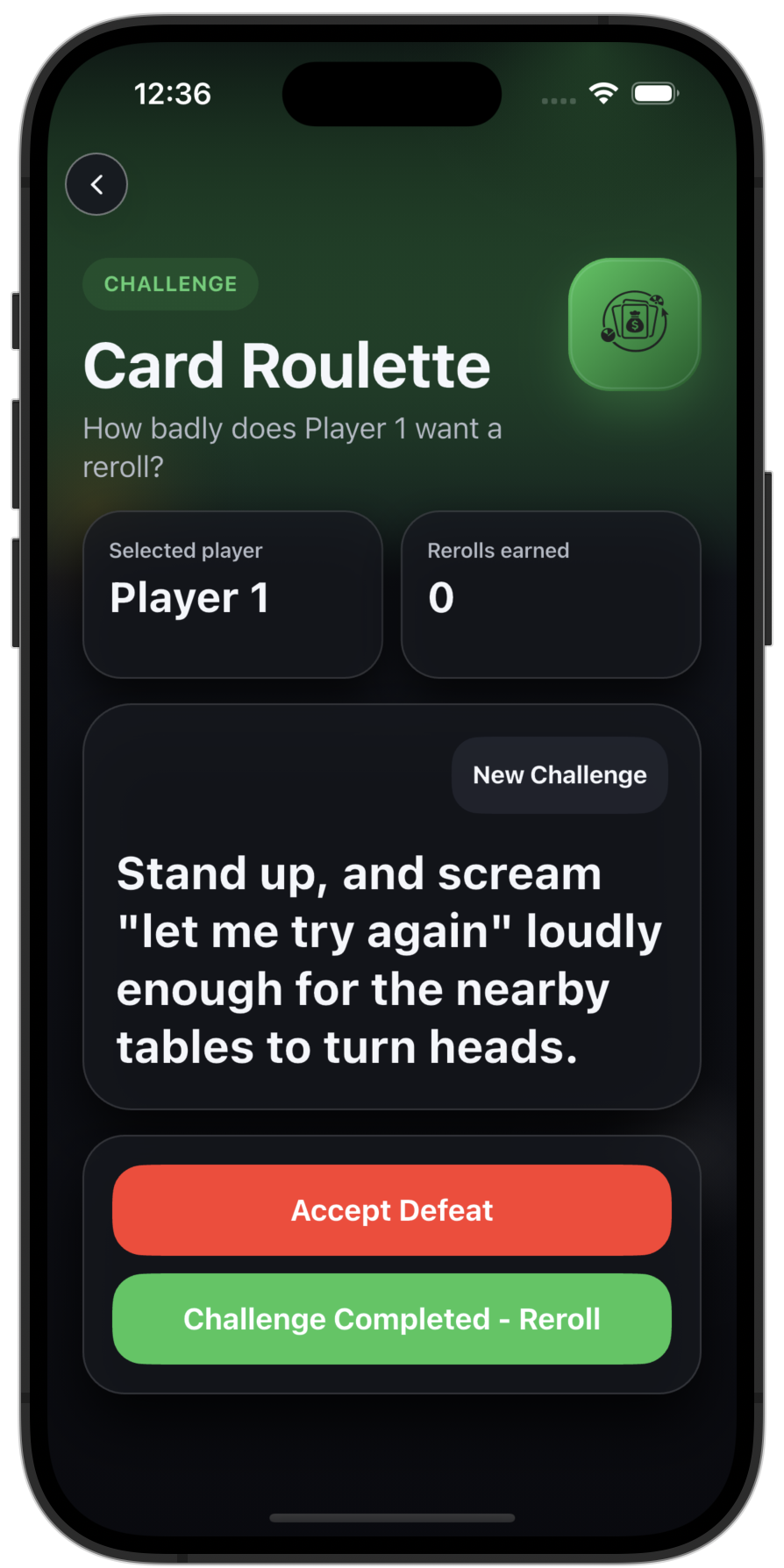
Card Roulette keeps the draw mechanic that makes card drinking games work. A player taps the screen, a card appears, and the prompt tells them what to do. The game holds the rules so nobody needs to remember which suit means drink and which means dare.
The prompts scale in intensity as the night goes. Early draws stay light. Later draws push the group. That arc replaces the house rules that groups layer onto a deck, but it happens without anyone negotiating the progression beforehand.
Passing the phone replaces dealing. The phone moves around the circle the same way a deck would, but it shuffles itself, never runs out, and never needs a flat surface. A standing circle at a house party works as well as a table.
The other advantage is variety. A physical deck gives you 52 draws and then repeats. Card Roulette pulls from a larger pool, so the group sees fresh prompts across multiple sessions without the repetition that kills a deck after three uses.
- No missing cards or bent corners.
- Rules built into each draw, no negotiation needed.
- Works standing, sitting, or on the move.
- Larger prompt pool than a 52-card deck.
Other drinking games without cards that fill a night
Card Roulette anchors the night, but two other modes extend it. First To Last To opens the session fast. A prompt names who goes first or last to do something, and the group points and reacts. It warms up the circle before the main game and works as a palate cleanser between heavier rounds.
Guess That Word Extreme adds a different kind of pressure. One person gives clues while avoiding a forbidden word, and the room shouts guesses. The constraint forces creative descriptions that get funnier as the night goes. Groups add their own drink-on-miss rule, but the mode works without one.
Together, the three modes cover the shape of a drinking night: a quick opener, a loud middle, and a dare-heavy closer. Rotating between them keeps the group from settling into one rhythm long enough to lose interest.
How to run a card-free drinking night
Start with First To Last To to pull the group together. It asks nothing of anyone except a reaction, so even the guests who just arrived join without a briefing.
Move to Guess That Word Extreme once the circle is loud. The forbidden-word constraint produces the memorable moments that drinking games exist for: someone trying to describe a word they cannot say while the room roars wrong answers.
Close with Card Roulette when the group wants the stakes to rise. The dare-style draws land hardest late in the night, and the pass rule means anyone can skip a card without stopping the round. Keep the phone moving and let the group decide when to stop.
One phone covers all three modes. No cards to find, no board to set up, no rulebook to argue over. The host opens the app and the night runs.