
What breaks when the group gets big
Turn-based games collapse first. At ten players, a round of anything that waits on one person at a time means nine people sit idle. By the time your turn comes back, you have checked your phone, started a side conversation, or left for the kitchen.
Physical components break next. A board game with a six-player maximum locks out a third of the room. A deck of cards needs a table big enough for ten to sit around. Trivia apps that pair every phone need ten downloads, ten accounts, and ten stable connections at the same time.
The real problem is attention. A large group generates its own gravity. Conversations pull people away from the game unless the game gives everyone a reason to stay in the same moment. A format that runs on shared attention instead of individual turns survives this.
Why phone games scale where board games do not
A phone game that runs on one device removes the cap entirely. There are no missing pieces, no extra controllers, and no lobby to join. The phone sits in the middle and the crowd plays around it.
The better phone games use group-answer formats. Instead of waiting for one person to take a turn, the whole room reacts at once. A prompt names a person or asks a question, and ten or twenty people point, shout, or sing at the same time. Nobody waits.
Passing the phone handles modes that need a single player. The guesser holds the device, the room gives clues, and then the phone moves to the next person. Even in a large group, the rest of the room stays active as the cluegiver rather than sitting in silence.
One phone also means one host controls the pace. At a large gathering, you need someone steering. A host who holds the app and calls the next round keeps a big room focused better than a leaderless free-for-all.
- No player cap: the room is the limit.
- Group-answer formats keep everyone active.
- One host steers the pace for the whole crowd.
- No downloads, accounts, or lobby codes needed.
The modes that work for 10 or more
First To Last To is the strongest pick for a large group. A prompt names who goes first or last to do something, and the room points and laughs together. Every person in the circle participates on every round. There is no idle turn and no spectator problem.
Sing That Song turns a crowd into an advantage. A music prompt drops, and the more people in the room, the more likely someone catches the answer first. The race to sing or shout the title rewards group size instead of punishing it.
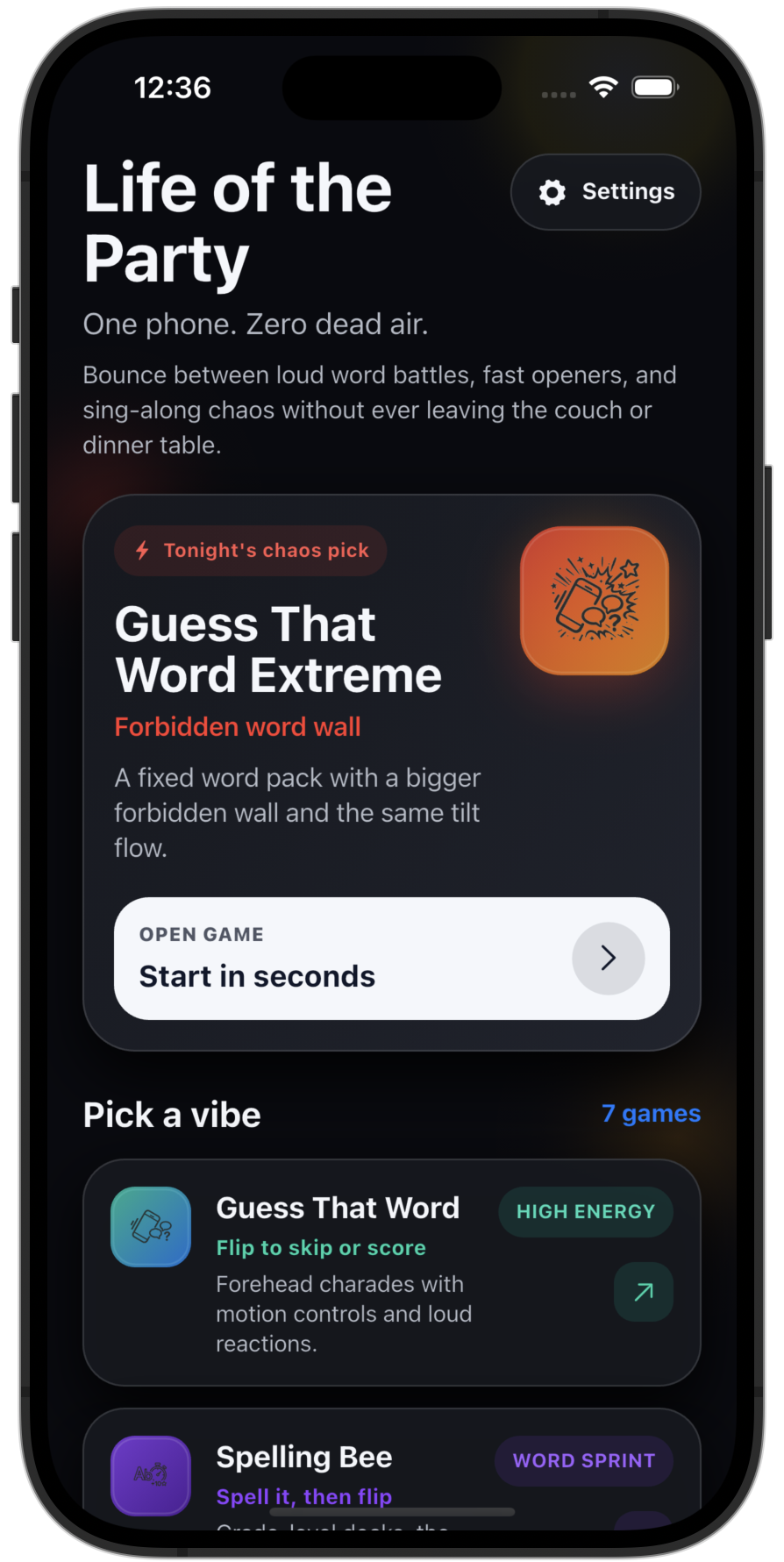
Guess That Word puts one guesser in front of the crowd, and the rest of the room becomes the clue team. At ten or more players, the clues come faster, the volume rises, and the guesser faces a wall of hints. The energy builds with the headcount.
How to run games for a large group
Start with a mode that needs no explanation. First To Last To teaches itself on the first prompt. When ten or more people stand in a circle, a long rules speech loses half of them before the game starts.
Keep rounds short and rotate modes. Large groups burn through energy fast. Three rounds of one mode, switch to another, repeat. The shifts prevent the room from settling into side conversations.
Position the host where the group can see them. In a big room, the person holding the phone is the focal point. Stand near the center, project the prompt with your voice, and keep the game visible. A host who hides in the corner loses the far side of the room.
Use team splits for competitive modes. Divide the room into two or three teams for Guess That Word and the guessing becomes a relay. Teams give large groups structure without slowing anything down.